



Net Revenue Retention isn’t a Customer Success metric. It’s a company metric. The organizations that realize this first will win.
There is a quiet dysfunction running through most SaaS companies. A small team, — usually called Customer Success (CS), is handed the most consequential metric in the business: Net Revenue Retention. They are measured on it, bonused on it, and held accountable for it. And then they are asked to achieve it with one hand tied behind their back, entirely dependent on decisions made by product, engineering, support, and leadership — teams whose compensation is tied to anything but.
This is an organizational design failure. And there’s a better way.
Net Revenue Retention captures how much revenue you retain and expand from your existing customer base over a given period. It accounts for renewals, expansion, contraction, and churn. A 110% NRR means your existing customers grew in value by 10% — without acquiring a single new logo. A 90% NRR means you are bleeding out, regardless of how many new deals your sales team closes.
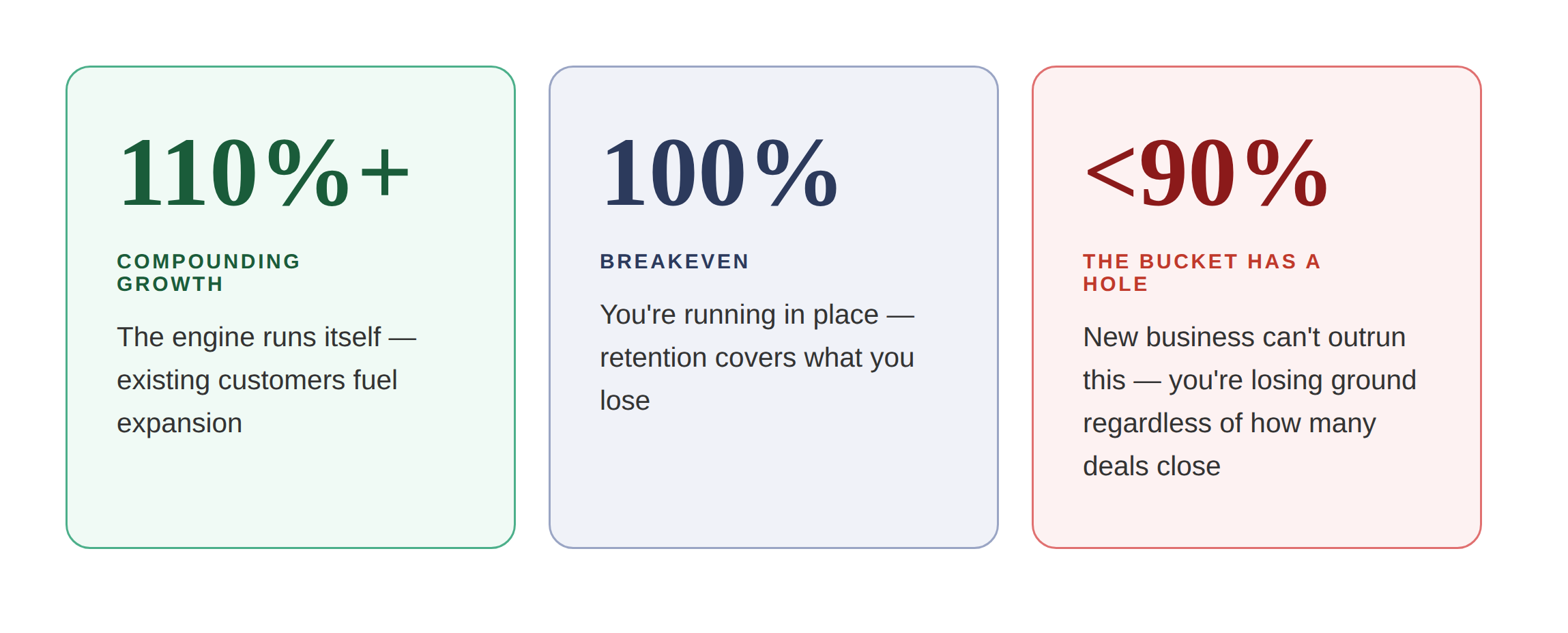
Elite SaaS companies — Snowflake, Veeva, Datadog — sustain NRR well above 120%. They do it not because their CS teams are extraordinary, but because their entire organization is oriented around delivering continuous value to customers. That orientation is not accidental. It is structured.
When NRR belongs only to Customer Success, a predictable set of pathologies emerges. CS raises a flag about a product gap driving churn. Engineering prioritizes features for new logo demos instead. Support tickets pile up around a known friction point. Finance structures multi-year contracts that accelerate initial cash but create renewal risk. HR hires for the wrong profile in client-facing roles. Marketing builds campaigns around acquisition, ignoring the story of customers already in the fold.
None of these teams are malicious. They are rationally optimizing for the goals they are paid against. The problem is structural: you cannot expect cross-functional alignment on an outcome if cross-functional compensation doesn’t reflect it.
“You get what you measure — and you lose what you only ask one team to measure.”
Every team shapes retention. Every team should own it. Consider what each function actually controls when it comes to keeping and growing customers:
How each team contributes to NRR
Product and engineering decide whether the roadmap solves real customer problems or just wins demos. Support determines whether a frustrated customer gets rescued or quietly starts evaluating alternatives. Product marketing controls whether existing customers understand the value they are already receiving, and expansion opportunities often hinge entirely on that awareness. Finance shapes whether contract structures feel like partnerships or traps. HR hires the people who represent you in every customer interaction, and designs the culture that those people work within.
These are not peripheral contributions to NRR. They are central to it. Excluding these functions from NRR-based compensation is not just incomplete; it actively undermines the CS team trying to carry the metric alone.
New business generation — typically your sales development and account executive functions — operates on a fundamentally different motion. Their goal is to open new relationships, and their compensation reflects that: quota-driven, milestone-based, oriented around new logos and initial contract value. Folding NRR into that model creates conflicting incentives. Let new business stay on new business. Everyone else ties to NRR.
When NRR becomes a shared compensation element across the organization, the dynamics shift in ways that are difficult to achieve through culture change or leadership messaging alone.
Roadmap conversations change. When product and engineering have skin in the game on retention and expansion, the customer feedback loop becomes financially relevant to them. Bugs that cause churn get prioritized differently. Features that unlock expansion get resourced. The question “will existing customers value this?” gets asked in rooms where it previously wasn’t. Support escalations get taken seriously. When a support leader is compensated in part on NRR, chronic friction points stop being someone else’s problem. There is a direct incentive to surface patterns, escalate systemic issues, and measure resolution quality not just ticket volume.
Finance becomes a retention partner. Billing confusion, inflexible contract terms, and punishing renewal structures are among the most underappreciated drivers of churn. A finance team with NRR exposure starts asking different questions about how deals are structured and how renewals are managed.
HR hires differently. When people and culture leaders are connected to the customer outcome, job descriptions get sharper, onboarding programs center customer empathy, and the company’s definition of “high performer” starts to include how someone shows up for customers — not just internal stakeholders.
The CS seat at the table
When the whole company is bonused on NRR, the insights, stories, and early warnings that CS holds become currency. Customer feedback stops being anecdote and starts being signal. CS leaders stop being the bearers of bad news and become the most valuable intelligence function in the building.
For years, Customer Success teams have faced a frustrating paradox: they hold the richest information about what customers actually experience, yet their influence over the decisions that shape those experiences is limited. They report churn risk upward and watch the roadmap move on. They flag friction and watch support tickets get closed, not fixed. They advocate for customer investment and get a polite nod before the next new logo celebration.
This happens because information asymmetry without financial symmetry creates no urgency. When nobody else is paid against the outcome CS is managing, CS voices are easy to deprioritize.
Change the compensation structure and you change the physics of that conversation. When a product leader, a support director, and a CFO all have NRR exposure, the Customer Success team’s quarterly readout stops being an informational courtesy and becomes the most important meeting of the quarter. CS finally gets the seat at the table it has always deserved, not because of politics or persuasion, but because the economics demand it.
A company-wide NRR compensation model does not need to be binary or identical across roles. It can be implemented as a modifier where a portion of variable compensation is tied to company-level NRR performance rather than as the sole driver of pay. The weighting can reflect proximity to the customer: CS and support carry more NRR exposure, while HR and compliance carry a smaller but still meaningful component.
What matters is not the exact percentage. What matters is that every team in the building has a financial reason to care whether customers stay, expand, and succeed. The metric creates the conversation. The conversation creates the behavior. The behavior creates the outcome.
“Retention is not a Customer Success problem. It is a company problem. Treat it like one.”
The companies winning on NRR today are not winning because they hired better CSMs. They are winning because they built organizations where every function understands that the company’s growth engine runs on keeping customers happy — and where compensation ensures that understanding isn’t optional.
That is the model worth building toward. It is simpler than it sounds, and the return compounds over time.