

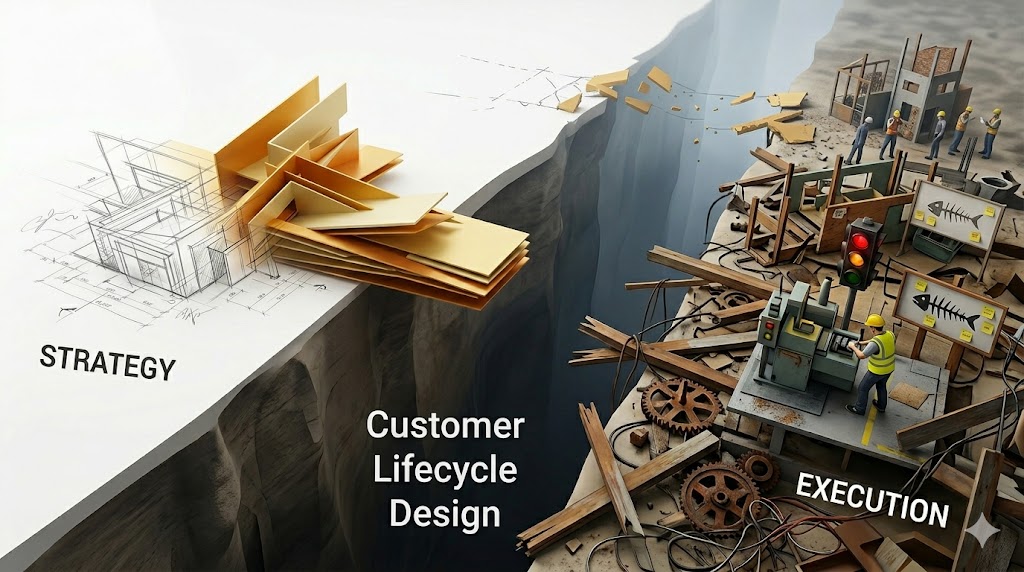

There’s a conversation happening in boardrooms and on Zoom calls across B2B companies right now. A CRO walks in with a clear strategic vision: “We need to focus on high-potential accounts. We need to improve our retention. We need to move upmarket.” Everyone nods. The slide deck is compelling. And then… not much happens.
The gap isn’t strategy. The gap is design.
And closing that gap is exactly what Customer Lifecycle Design and Operations is built to do – something that Revenue Operations, as traditionally practiced, has never quite managed.
Revenue Operations emerged as a necessary evolution beyond siloed sales, marketing, and customer success functions. Unifying those teams under shared data and process was the right idea. But somewhere along the way, RevOps got reduced to a support function.
Ask ten companies what their RevOps team does and you’ll hear some version of the same answer: Salesforce administration, reporting dashboards, territory management, maybe some commission processing. Important work, certainly. But a far cry from the strategic potential the function was supposed to unlock.
The reasons are structural. RevOps sits downstream of strategy and upstream of execution leaving it reactive by nature. When the CRO says “target high-potential accounts,” RevOps gets asked to build a report on account scores that already exist, not to design the scoring model, the routing logic, the handoff SLA, or the playbook that determines what “targeting” actually means in practice.
Enter the Customer Lifecycle
Here’s a distinction worth making carefully: the customer journey and the customer lifecycle are not the same thing.
The customer journey is an external construct. It maps how a customer experiences your company – the touchpoints, the emotions, the moments of friction or delight. Journey mapping is a marketing and CX discipline. It’s valuable. But it lives at the surface.
The customer lifecycle is an internal construct. It describes how your business operates across the full arc of customer engagement – from the moment a lead enters your funnel through renewal, expansion, and advocacy. It’s about the processes, handoffs, roles, data flows, and operating cadences that determine whether the customer’s experience is actually any good.
You cannot design a great customer journey without first designing a great customer lifecycle.
This is the operating premise of Customer Lifecycle Design and Operations.
The word design is intentional and it’s doing real work.
Traditional RevOps asks: “how do we operate this machine?”
Customer Lifecycle Design and Operations asks: “have we designed the right machine in the first place?”
That design work spans the full commercial arc – MQL through opportunity through closed-won through onboarding through renewal and expansion – and it includes everything that determines whether each stage actually functions:
The best way to understand the relationship between Customer Lifecycle Design and Operations and senior revenue leadership is through the chief of staff analogy.
A CRO operating at the strategic level who is setting direction, managing board relationships, leading a cross-functional team, and carrying quota cannot also be the person who translates “focus on high-potential accounts” into an ICP definition, a scoring model, a routing rule, an SDR playbook, an AE qualification framework, and a CS handoff checklist. The bandwidth simply isn’t there.
Customer Lifecycle Design and Operations fills that translation layer. It takes strategic intent and converts it into the specific, executable design that makes the strategy real.
This is not a support function. It’s not Salesforce administration. It’s architecture work, operating at the intersection of business design and revenue execution.
Two forces are converging to make Customer Lifecycle Design and Operations not just differentiated but essential.
The AI inflection point: Every company is either deploying or planning to deploy AI across their go-to-market motion (ie. AI for outreach, AI for forecasting, AI for risk scoring, AI for CS workflows). Here’s the uncomfortable truth – AI doesn’t rescue messy operations or bad data. It amplifies them. If your handoffs are undefined, AI will automate the wrong handoffs at scale. If your data is inconsistent, AI will make confident predictions from incoherent inputs. Clean, standardized, well-designed internal operations are the prerequisite for AI to deliver value rather than chaos.
The efficiency imperative: The era of growth-at-all-costs is over. Companies are being asked to do more with existing customer relationships by driving expansion, improving retention, getting more value from customers they already have. NRR is the metric of the moment. But NRR is downstream of operational design. You cannot improve what you haven’t defined.
Consider a real scenario: a growth-stage SaaS company whose CRO wants to move upmarket. The strategy is clear. The gaps are everywhere.
Revenue Operations, in the traditional sense, might be asked to build a dashboard showing win rates by account size. It might update HubSpot fields to capture a new “segment” designation.
Customer Lifecycle Design and Operations approaches the same situation differently. It starts with the full arc: what needs to be true at each stage of the lifecycle for this upmarket motion to actually work? It defines the ICP criteria, the scoring model, the routing logic, the revised RACI between Sales and CS, the onboarding SLAs with enforcement mechanisms, the expansion playbook, and the forecasting methodology. Then it specifies the system requirements and operationalizes them without getting lost in CRM administration for its own sake.
The output isn’t a report. It’s a functioning operating model.
Naming matters. “Revenue Operations” carries twenty years of accumulated associations mostly administrative, mostly reactive, mostly tactical. When you lead with that label, you’re fighting those associations on every sales call and every internal budget conversation.
“Customer Lifecycle Design and Operations” says something different. It says: we design things. We think about the full arc of the customer relationship, not just the pipeline. We operate with intention.
That distinction isn’t cosmetic. It reflects a genuinely different scope, a genuinely different posture, and a genuinely different level of impact.
The companies that figure this out first will build commercial operations that are faster, more measurable, and more resilient than anything their competitors have. The ones that keep calling it RevOps and staffing it accordingly will keep wondering why their strategy never quite lands.
Fractal River partners with growth-stage B2B companies to design and operationalize their full customer lifecycle from first touch through renewal and expansion.